Media & Engagement
Media can turn cultural research into something people can see, experience, and respond to. Through digital storytelling, education, exhibitions, and public dialogue, I explore different ways of sharing cultural knowledge and inviting others into the conversation.
Digital Storytelling
What happens when living heritage enters a screen? Through virtual reality, animation, and visual storytelling, I experiment with ways of making cultural knowledge accessible while preserving its context, complexity, and connection to the people who carry it.
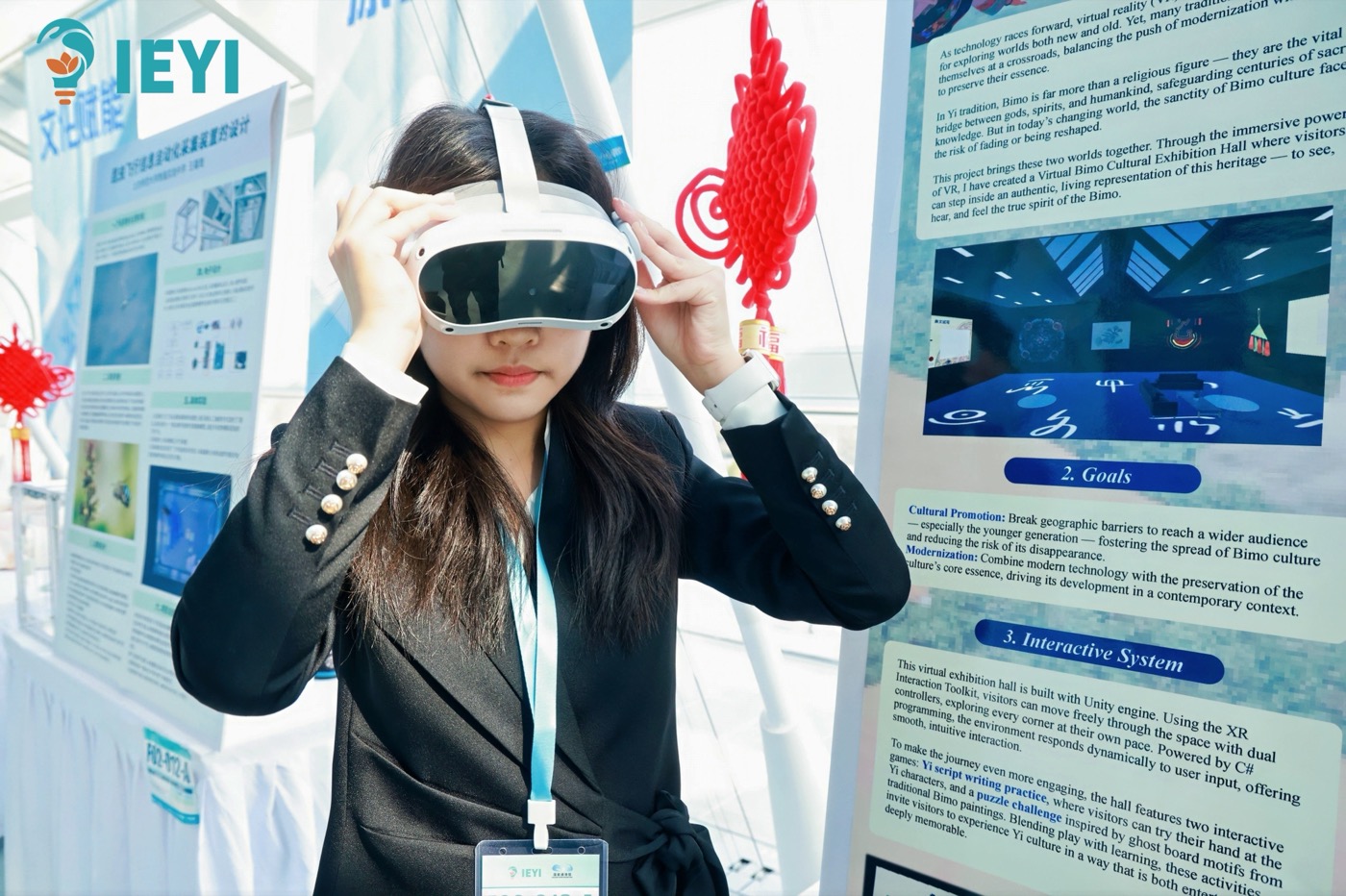
National Bronze Award and Regional Distinction, International Exhibition for Young Inventors (Selected from 500+ entries by 151 teams across 13 countries/regions)
A Virtual Museum of Yi Bimo Culture
How can a virtual space introduce a living spiritual tradition without turning it into spectacle? I created an immersive VR museum centered on Yi Bimo heritage, integrating cultural spaces, symbolic imagery, Yi script, interactive games, and knowledge assessments. Visitors do not simply view information; they explore, write, solve, and respond. The project considers how emerging media can expand access to cultural knowledge while preserving the context, beliefs, and meanings that make that knowledge more than a collection of visual symbols.
Can visibility preserve culture without simplifying it?
This stop-motion project approaches Yi culture through the rhythms of everyday life: the family hearth, embroidery, language, Bimo rituals, songs, myths, and oral traditions. Rather than presenting heritage as a collection of isolated customs, the animation follows how knowledge moves through families and communities. It also considers a central tension within cultural tourism: visibility can support preservation, yet the same process can separate cultural forms from their sacred and social meanings.
Public Voice & Curating
Some ideas need to be encountered, not only read. Through exhibitions, public speaking, and cultural advocacy, I bring research into public spaces and create opportunities for audiences to reconsider familiar narratives of identity, heritage, and belonging.
Selected Youth Speaker, 2026 United Nations High-Level Political Forum (Playback from 15:00)
A Youth Global Call for Culture and Sustainable Development
At the UN High-Level Political Forum youth session, I shared that living cultural heritage should be treated as part of sustainable development rather than as a decorative addition to it. Drawing on my fieldwork in Liangshan, I examined how tourism, globalization, and commercialization can weaken community agency. I also questioned whether existing measures capture what cultural preservation truly means, proposing a broader framework that considers transmission, participation, language, identity, community control, and cultural continuity.
A Rights-Based Approach to Commercial Appropriation
Cultural Heritage Rights Proposal
Who has the right to use, reinterpret, or profit from cultural heritage? For the Beijing Changier Education Foundation, I authored a UN Human Rights Council statement framing intangible cultural heritage as a human-rights issue. Comparing disputes involving the Chinese mamianqun and the Mixe blouse, I examined gaps across UNESCO, WIPO, and intellectual-property frameworks. The proposal moves beyond the question of resemblance to consider whether communities have been recognized, consulted, credited, and compensated.
Read Full Proposal →Curatorial Process (Photo carousel pending)
An Exhibition of Identity and Memory
History Worn transforms archival research into a public encounter with school memory. Through uniforms, historical photographs, oral accounts, and visual timelines, the exhibition invites visitors to consider how institutional identity is worn and remembered. Rather than presenting 110 years as a linear sequence of changing designs, it reveals the values embedded in fabric, color, and form—and asks students to see themselves as part of a history that continues to be revised.
Learning & Community
Culture remains alive when people are invited to participate in it. These projects transform learning into an exchange—one in which students create, question, remember, and contribute their own experiences to a larger cultural story.
Gold Award (Top 1%), UNESCO Clubs Youth Multimedia Contest
A Curriculum for Practiced Heritage
I designed Living Cultures to help students experience cultural heritage as something practiced, questioned, and recreated—not simply memorized. Structured around language, visual art, performance, and belief, the curriculum invites students to learn ethnic scripts, make traditional art, explore cultural narratives, and reflect on how traditions change. The project culminates in student-led presentations and exhibitions, allowing young participants to become contributors to cultural preservation rather than passive audiences.
The First Ethnic Culture & Heritage Service Club
I founded Echoes of Cultures as the first student-led club at my high school dedicated to ethnic culture and heritage service. The club grew from my realization that ethnic cultures were often introduced through decorative symbols while their histories and contemporary challenges remained invisible. Through cultural research, workshops, digital storytelling, and student-led action, members have created cultural products, taught younger students, adapted the Bimo VR Museum for classroom learning, and published stories for wider audiences.
Culture in the Classroom
Workshops in Beijing Primary Schools & Left-behind Children Centers
Through storytelling, cultural interpretation, and hands-on activities, our members introduced students to the meanings, histories, and contemporary challenges behind Yi lacquerware, Bai tie-dye, and other cultural traditions.
Designing with Purpose
Self-designed Cultural Products
We transformed cultural research into original products that connected traditional references with contemporary student design. Proceeds from their sale funded learning materials and cultural classes in Liangshan, while selected products were donated directly to local children.
Returning to Liangshan
A Community-Based Workshop with Yi Students
Working alongside with local NGO volunteers, we brought the project back to the community that had shaped much of my research. The workshop combined family memory, Yi-language keywords, visual storytelling, and jewelry making. We also provided course materials and donated products to participating children, turning cultural research into a form of continued learning and exchange.
Auto-scroll gallery (IMG_3615 · IMG_1796 · IMG_9160 · DSC08691 · DSC05366)
Head of the Arts Department
As Head of the Arts Department, I coordinated large campus traditions, connected multiple departments, represented student proposals to school leaders, and helped revise election and organizational rules. Whether planning a music festival or improving internal governance, I learned to balance creative ideas with logistics—and to turn individual opinions into experiences and decisions shared by a larger community.
Selected photos auto-scroll
Campus Baking for Educational Support
I co-founded DolceBloom Baking with three core members and recruited fourteen peers, building a team that connected campus baking with educational support. I developed fundraiser plans, tested dessert menus, assigned production and sales roles, and managed pricing and accounts. Through three campus sales of cupcakes, cookies, and panna cotta, we raised funds to purchase and deliver essential learning materials to children at a rural primary school in Hubei Province.